
Introduction
In the field of financial planning, SAP offers a variety of tools: BW-IP, BPC Embedded and SAC Planning, each adapted to specific planning, reporting and consolidation needs. In addition, with the rise of the cloud, many companies are wondering which is the most modern, high-performance solution. This article compares BPC Embedded and SAC Planning, presenting their main characteristics, advantages, disadvantages, features and costs, to help you make the best choice.
In general
SAP BPC Embedded and SAC Planning are two SAP planning solutions offering advanced budgeting, forecasting and simulation functionalities. What they have in common is their ability to structure and automate the planning process, while ensuring integration with SAP systems.
SAP BW-IP/BPC Embedded
Difference between SAP BPC and SAP BPC Embedded
SAP BPC Standard is a simple, stand-alone solution for business users, while BPC Embedded, integrated with SAP BW, offers more flexible but more technical real-time planning.
Features of SAP BPC Embedded
BPC Embedded is SAP's on-premise financial planning, budgeting and consolidation tool, optimizing reporting and compliance. BPC Embedded has several features:
- Strong integration with SAP tools (ERP, SAP BW 7.5 on HANA, BW/4HANA, etc.) as the tool is directly integrated with SAP BW.
-
Thanks to its planning tools (planning function, fox formula, etc.), this solution makes it possible to create complex planning models tailored to the specific needs (phasing of cost of sales) of companies. In this way, virtually all planning requirements can be covered.
On the other hand, SAP BW-IP/BPC Embedded does have some disadvantages to consider:
- The interface, although integrated with Excel (data entry), is less intuitive than modern cloud solutions.
- Use of the tool requires technical expertise for configuration, development and administration.
- Functionality evolution is slower than for SAP's new cloud solutions.
Definition of key concepts:
- Aggregationlevel: planning object that defines the level at which data is grouped according to specific dimensions (color, size, speed, etc.), enabling it to be captured, analyzed and processed efficiently.
- Planning function: SAP BPC Embedded and SAP BW-IP tool for modifying, calculating or transforming planning data according to defined rules.
- FOX Formulas: SAP script dedicated to planning calculations in BPC Embedded and BW-IP, used in particular for EAC estimation.
- BW filter: in a planning sequence, limits the processing of a planning function to a defined scope of data (e.g. period, product, entity).
- Planning Sequence: Suite of sequenced functions to automate and structure planning in BPC Embedded or BW-IP.
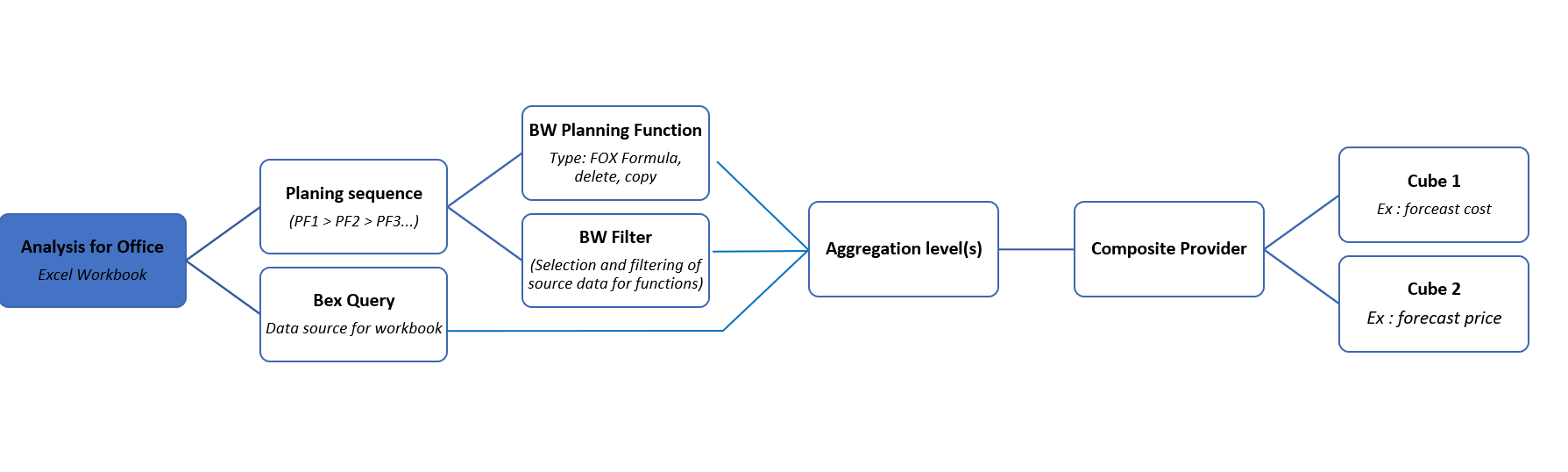
This diagram shows how Excel and Business Warehouse (BW) process data, from a Bex query to filtering and cube storage, to facilitate analysis and planning.
Data integration with SAP BW IP/BPC Embedded
As SAP BPC Embedded is fully integrated with SAP BW, the latter has the same data integration capabilities, so it can integrate with SAP and non-SAP solutions via a variety of methods.
SAC Planning
SAC Planning features
Launched in 2015, SAP Analytics Cloud (SAC) Planning is a cloud solution from SAP designed to optimize planning, budgeting, and forecasting.
It stands out mainly for:
Its flexibility, seamless integration with SAP and non-SAP data by connecting natively to SAP systems (S/4HANA, BW, BPC Embedded) and external data sources.
There are two main types of planning scenarios when integrating with on-premise systems (SAP BW-IP/BPC Embedded):
In the first case, SAC serves only as a front-end platform for data entry in the report, but the data is still stored in on-premise systems.
In the second case, data is imported from data sources where it will be stored in Datasphere. Planning is carried out exclusively in SAC.
SAC also offers other interesting features in terms of financial planning:
- SAC Planning promotes real-time collaboration by enabling teams to work simultaneously on the same models, thanks to integrated workflows.
- Unlike on-premise solutions, SAC Planning reduces IT costs by limiting infrastructure maintenance and management.
IA & SAC Planning
SAP Analytics Cloud (SAC) Planning integrates artificial intelligence capabilities that improve the efficiency, automation and accessibility of planning processes. Several concrete functionalities embody this evolution:
Generative AI
This feature automatically generates scenarios, forecasts or narrative comments from planning data. It simplifies the creation of financial projections and reduces the need for manual intervention, while delivering more consistent and relevant analyses.
Joule
Joule is an intelligent assistant that provides contextual recommendations and detects anomalies in real time. In a planning process, it helps users to quickly adjust their forecasts and identify necessary corrective actions, thus optimizing responsiveness to changes in the market or internal data.
Just Ask
Using natural language, Just Ask enables users to ask questions about their planning data, such as "What's the variance from budget this month?", and get instant answers, simplifying data exploration without technical expertise.
Augmented Analytics
Augmented Analytics in SAC uses AI to automate data analysis and accelerate the discovery of insights useful for planning.
Smart Insights
Smart Insights helps to quickly explain variations in key performance indicators (KPIs), by identifying factors that directly influence planning results, such as variances between forecasts and actual results.
Smart Discovery
Smart Discovery explores data to highlight hidden trends or relationships, helping planners adjust their strategies, for example, by detecting anomalies or underutilized segments in financial projections.
To learn more about artificial intelligence applied to planning, check out this article.
BPC Embedded vs SAC Planning
SAC BPC Embedded vs SAC Planning feature comparison
In terms of planning functionality, data actions and action plans in SAC Planning are the respective equivalents of planning functions and planning sequences in SAP BPC Embedded. Here's how the latter are characterized:
Data Actions
Data Actions are used in SAC Planning to perform calculations, transformations, or updates on planning data. They allow you to configure conditional calculations, distributions, projections, etc. They are similar to BW-IP Planning Functions.
With regard to Data Actions, you could also use script (SAP proprietary language) to apply calculations to data, such as distributions, aggregations, and other types of transformations.
Action Plans
Action Plans are sets of actions, including Data Actions, that coordinate a planning flow with steps defined in a specific order, providing a structure for executing planning tasks sequentially.
In summary, in SAC Planning, Data Actions and Action Plans play a similar role to the Planning Functions and Planning Sequence in BW-IP.
SAP BPC Embedded vs SAC Planning license cost comparison
SAP BPC Embedded operates on a one-time payment licensing model, requiring a significant initial investment for licenses and infrastructure, with recurring costs for maintenance and support, suitable for large enterprises. The cost of SAP BPC Embedded licenses depends on several factors, such as the number of users, the type of license, the infrastructure used, and additional services. There is no standard fixed cost; it is adjusted according to the needs of the company.
SAP Analytics Cloud (SAC) Planning follows a subscription model, offering a more flexible and affordable solution with predictable pricing, ideal for medium-sized businesses, although costs vary depending on the number of users and the features chosen. There are two main types of licenses for SAC Planning users:
- Standard User for data entry and modification.
- Professional User for creating templates, scripts and Data Actions.
The second option happens to be the most expensive in terms of cost.
It is important to note, however, that when using SAC Planning, the cost of licenses may be higher depending on usage, especially for companies that have already invested in on-premise solutions.
If a company already uses BPC Embedded, adding SAC Planning would incur an additional cost. On the other hand, a company that does everything in SAC only pays for a single license. Therefore, the cost is often higher for those who combine BPC Embedded and SAC Planning.
SAP BPC Embedded Vs SAC Planning summary :
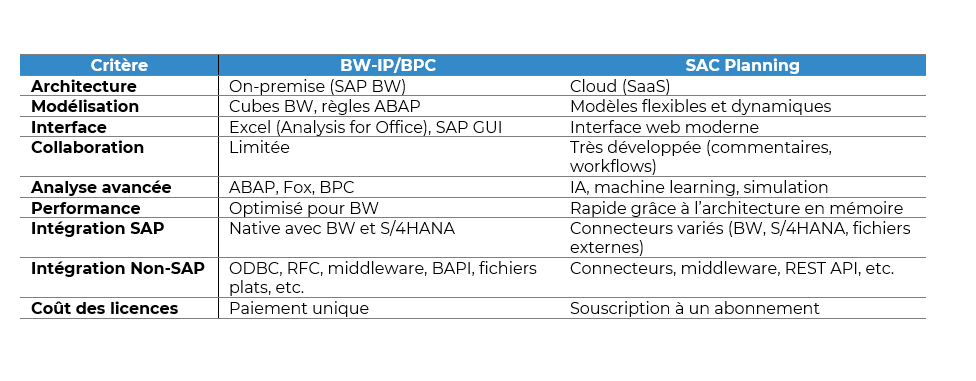
The choice between SAP BPC Embedded and SAC Planning depends on your priorities:
On the one hand, BPC Embedded is ideal for complex planning processes, offering advanced customization and strong integration with SAP, but with a longer learning curve (as it requires technical expertise) and high costs. On the other hand, SAC Planning, which is more modern and agile, promotes real-time collaboration and easy integration of external data. It is also the ideal solution if the company's objective is to control costs, particularly thanks to its subscription system with monthly or annual payments rather than a large initial investment.
However, SAC Planning remains limited in terms of automation for highly complex requirements. Although it offers scripting features to customize planning processes, these capabilities may be less robust and flexible than those offered by BW-IP, particularly for complex scenarios requiring in-depth integration and efficient management of large volumes of data. The choice will therefore also depend on the complexity of your processes and your cloud strategy.
Conclusion
BPC Embedded and SAC Planning meet specific needs and are aimed at companies with different requirements. BPC Embedded is suitable for organizations with an existing BW infrastructure, requiring complex ABAP or Fox-based rules. Conversely, SAC Planning offers a more modern, interactive experience, ideal for companies seeking to innovate and optimize their decision-making through cloud technologies and artificial intelligence.
Depending on your priorities - stability and integration with BW, or flexibility, cost and innovation with SAC Planning - one of these solutions will naturally emerge as the best choice for your business.